Technology
How JAX-BTE works, from quadrature to chip.
A complete walkthrough of the physics, the solver, the surrogates, and the coupling that makes chip-scale ballistic thermal modeling practical.
01 · The physics
Why Fourier fails at advanced nodes
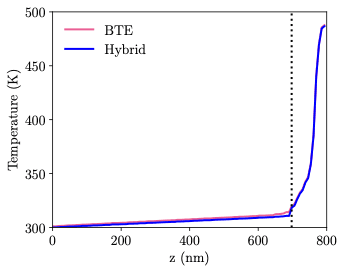
Phonon mean free path in silicon is ~40 nm at 300 K. Modern FinFET fin widths are under 10 nm. Heat carriers traverse the device ballistically — there is no diffusive regime to average over. Fourier's law, derived from a diffusive assumption, is not just imprecise here. It is the wrong physics.
02 · The solver
GPU-native tensor architecture
JAX-BTE stores phonon energy distributions as 3D tensors (spatial cells × spectral bands × angular directions) and solves on the GPU via vectorized JAX operations. Discrete ordinates method with Gauss-Legendre quadrature; non-gray band discretization; pseudo-time iteration with a BiCGSTAB linear solver. Up to 100 M degrees of freedom on a single A100.
03 · Performance
8× faster, on commodity GPUs
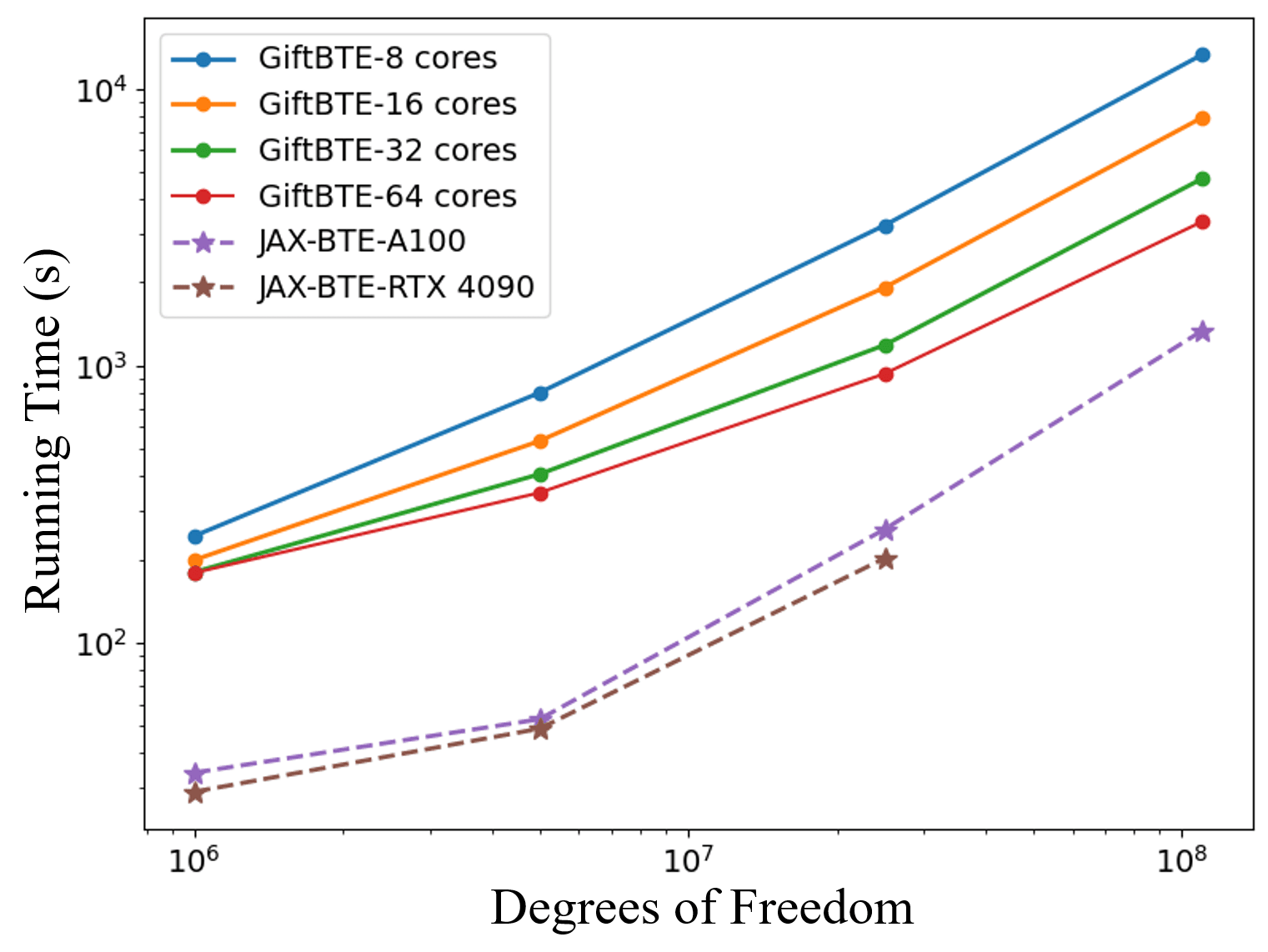
29 seconds on a single RTX 4090 to solve a 1 M DoF problem that takes 243 seconds across 8 CPU cores in the prior state-of-the-art (GiftBTE). The advantage grows with problem size up to GPU memory limits.
04 · Inverse design
Gradients through every step
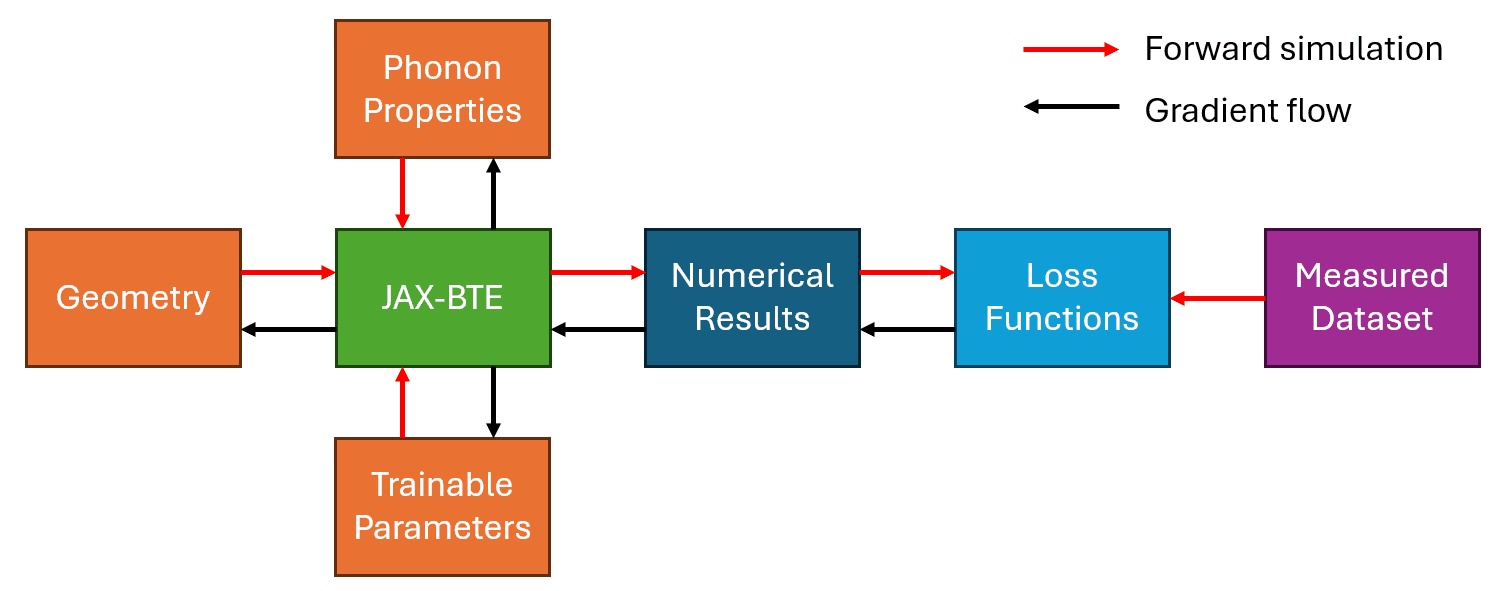
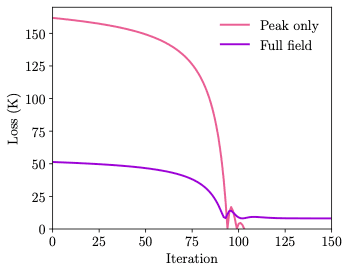
Because JAX-BTE is end-to-end differentiable — including the BiCGSTAB linear solve, via discrete adjoints — gradients flow through the entire solver. Recover film thicknesses in 25 iterations. Recover 2D heat source intensities in 10. From 20 sparse temperature observations. No other phonon BTE solver does this.
05 · Multiscale coupling
Sub-10 nm physics, chip-scale simulations
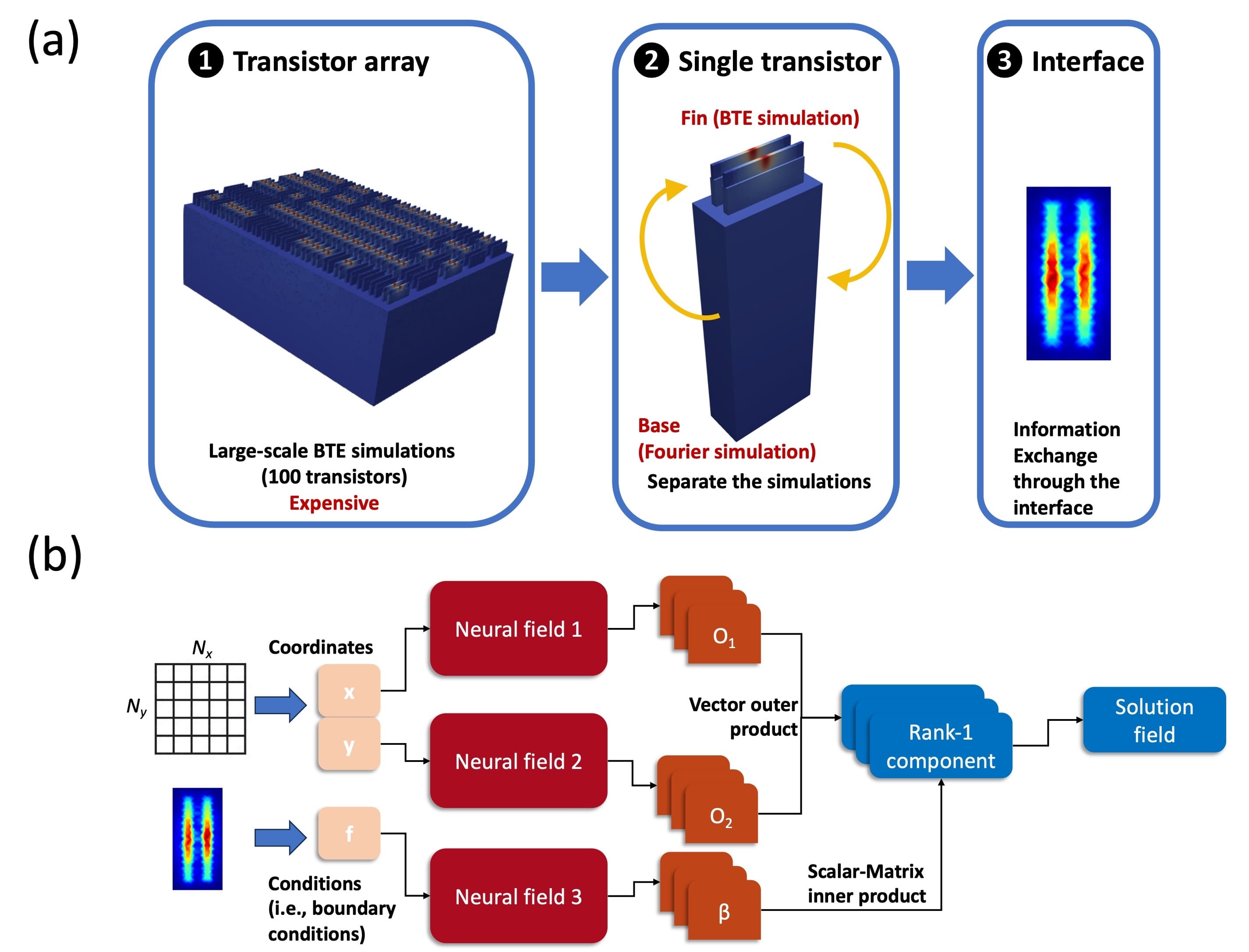
Direct BTE everywhere is intractable at chip scale. SOLDER decomposes the problem: BTE-accurate operator-learning surrogates in transistor regions where ballistic transport matters; spectral-kernel surrogates over the substrate where Fourier holds. Iterative boundary-condition exchange closes the loop. 7× speedup over full BTE, 74% memory reduction, sub-1 K error.
References
Published, patented, and reproducible.
The full method is described in our paper in npj Computational Materials. The end-to-end system is protected under PCT/US25/36027.